The CPTT Competency Framework
Developing Professional Competency Through Purposeful Education
At Canadian Pilot Truck Training Ltd. (CPTT), we believe professional competency is not achieved through compliance alone—it is developed through structured education, applied reasoning, professional judgment, and continual improvement.
Our Competency Framework serves as the institutional blueprint that guides every program we develop. It integrates our educational philosophy, instructional design standards, governance principles, and professional competency doctrine into a single coordinated system that supports the development of transportation professionals.
Whether developing a Professional Escort Vehicle Operator, Traffic Control Personnel, Route Survey Specialist, or Transportation Safety Professional, every CPTT program is built upon this common framework.
The following institutional model illustrates how the principles, systems, and governance of CPTT work together to develop professional competency.
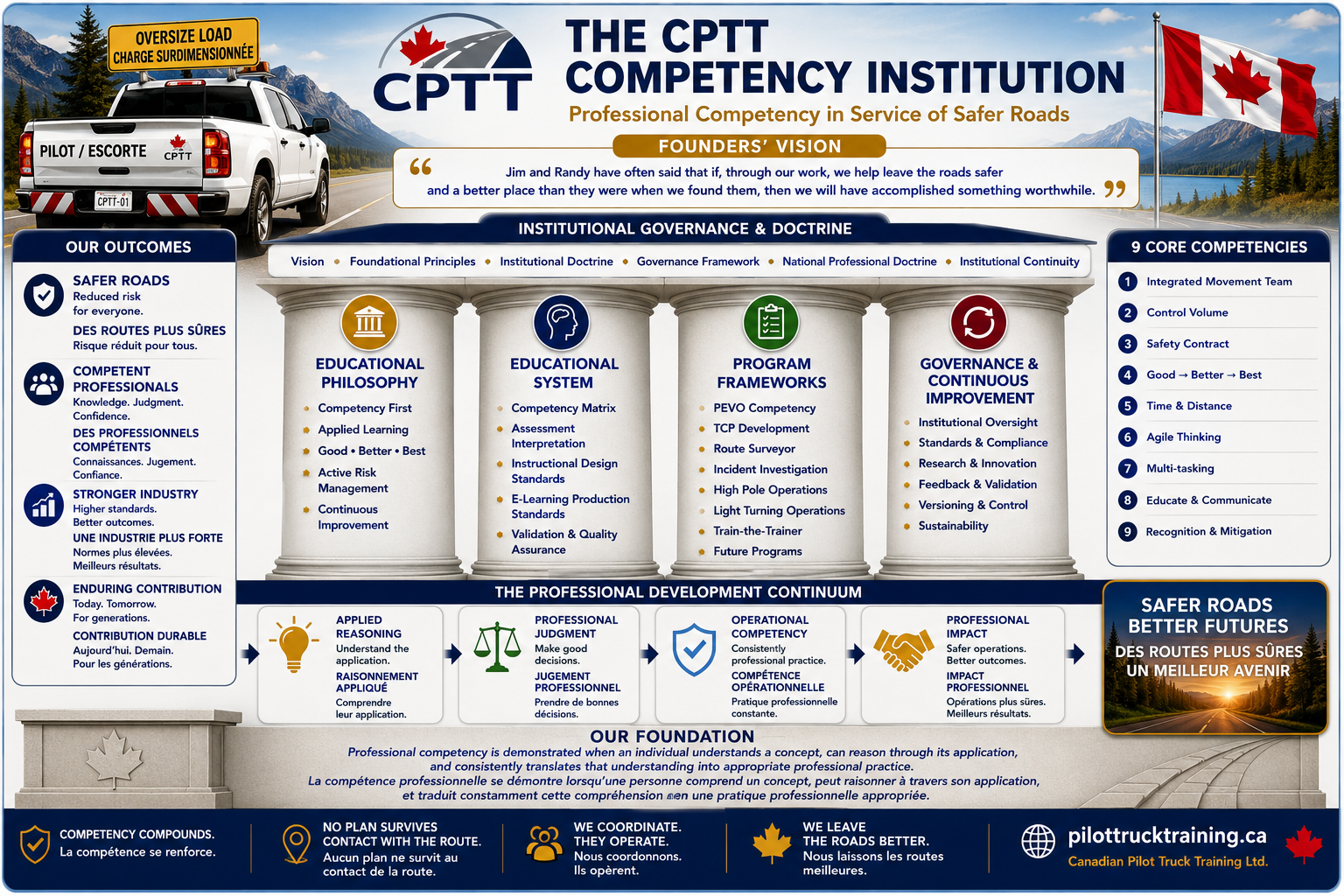
Figure 1. The CPTT Competency Framework
The institutional blueprint that integrates educational philosophy, instructional design, governance, competency doctrine, and continuous improvement into a coordinated professional development system.
The Nine Core Competencies
At the heart of the CPTT Competency Framework are the Nine Core Competencies. Together they form a coordinated professional competency system that develops the knowledge, judgment, communication, and operational capability required for specialized transportation operations.
Each competency strengthens a different aspect of professional performance. Together they create the capability required to plan, coordinate, communicate, recognize hazards, manage risk, and support safe transportation operations under dynamic conditions.
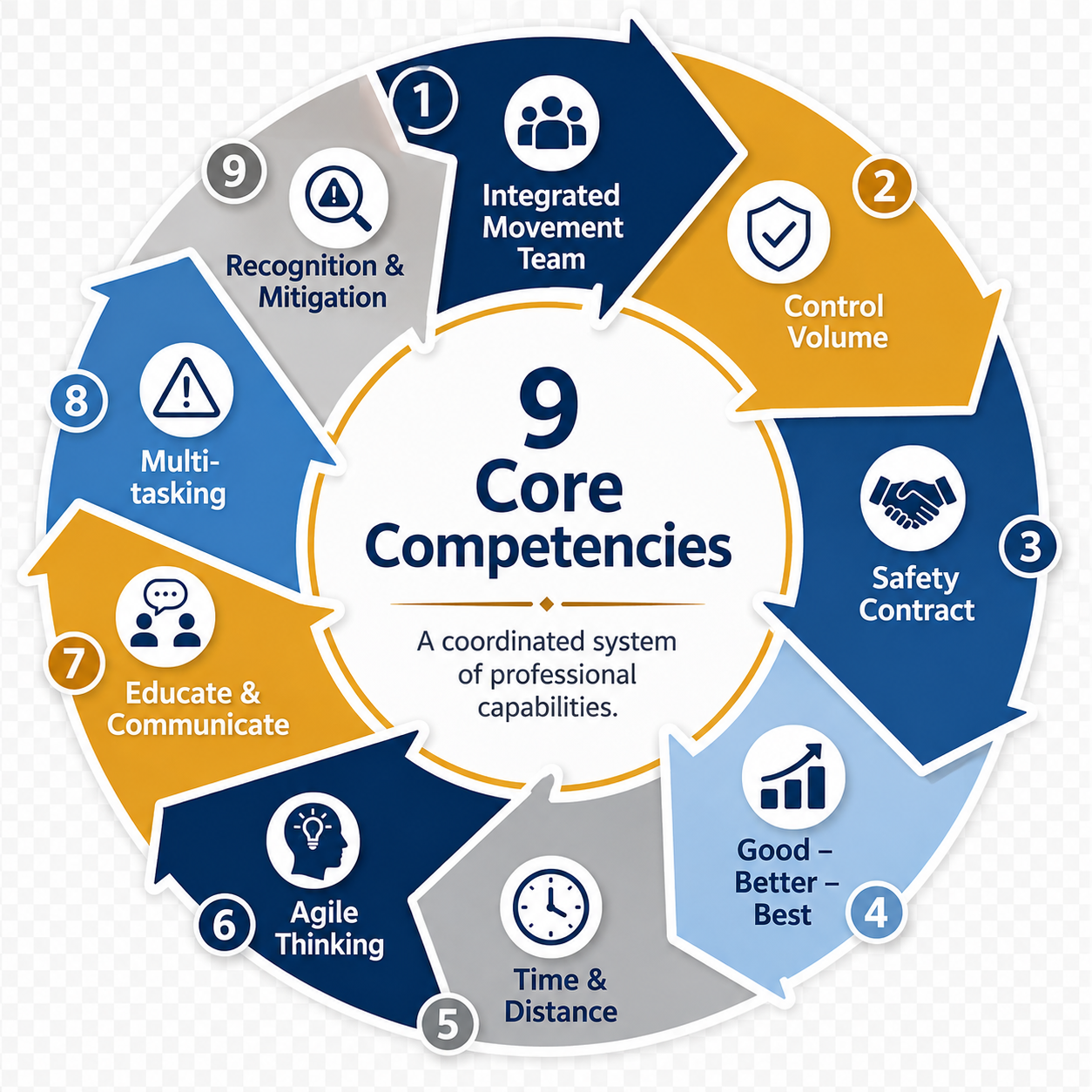
The First Five Core Competencies
The first five competencies establish the operational foundation required for professional transportation operations. Together they define how specialized movements are organized, protected, and executed safely under dynamic operating conditions.
1. Integrated Movement Team
Professional transportation operations succeed through coordinated teamwork. Every participant—including drivers, Professional Escort Vehicle Operators, traffic control personnel, clients, and regulatory authorities—contributes to a common operational objective. Effective coordination, communication, and shared situational awareness create a unified movement team.
2. Control Volume
Safe transportation operations require actively managing the roadway space surrounding the movement. The Control Volume protects four critical modalities: the travelling public, the movement team, infrastructure, and the load itself. Professional operators continuously adjust this protective space as conditions change.
3. Safety Contract
Every transportation operation establishes an implicit safety contract with workers, motorists, clients, and the public. Professional decisions should consistently strengthen trust by demonstrating sound judgment, predictable actions, and a commitment to protecting others.
4. Good → Better → Best
Professional competency is demonstrated through continual improvement in decision-making. Rather than accepting the first workable solution, competent professionals evaluate alternatives and select the option that provides the greatest operational effectiveness while minimizing risk.
5. Time & Distance
Time and distance are the fundamental resources that allow hazards to be recognized, communicated, and managed safely. Maintaining adequate separation provides the opportunity to make informed decisions, coordinate the movement team, and protect all four modalities throughout the operation.
The Final Four Core Competencies
The final four competencies develop the professional judgment and decision-making required to manage complex transportation operations under dynamic conditions. Together, they strengthen a professional’s ability to adapt, communicate, recognize hazards, and apply sound operational judgment in support of safe and effective transportation operations.
- Agile Thinking
Professional transportation operations occur in dynamic environments where conditions can change rapidly. Agile Thinking is the ability to assess evolving situations, adapt plans, and make sound professional decisions while maintaining safety, operational effectiveness, and control.
- Educate & Communicate
Effective communication ensures that every participant understands the plan, the hazards, and their responsibilities. Professional operators communicate clearly, provide timely information, and foster shared situational awareness throughout the movement.
- Multi-tasking
Professional operators must continuously monitor multiple sources of information while prioritizing safety-critical tasks. Effective multi-tasking combines observation, communication, planning, and decision-making without losing focus on the overall operation.
- Recognition & Mitigation
Professional competency depends on recognizing hazards before they become incidents and implementing effective measures to reduce or eliminate risk. Continuous hazard recognition and mitigation support safer, more reliable transportation operations.
= Managing Lives & Situations (Outcome)
Managing Lives & Situations is not a separate competency—it is the outcome produced when the Nine Core Competencies are applied together. Professional operators use these coordinated competencies to protect people, manage risk, and successfully navigate complex transportation operations under dynamic conditions.